

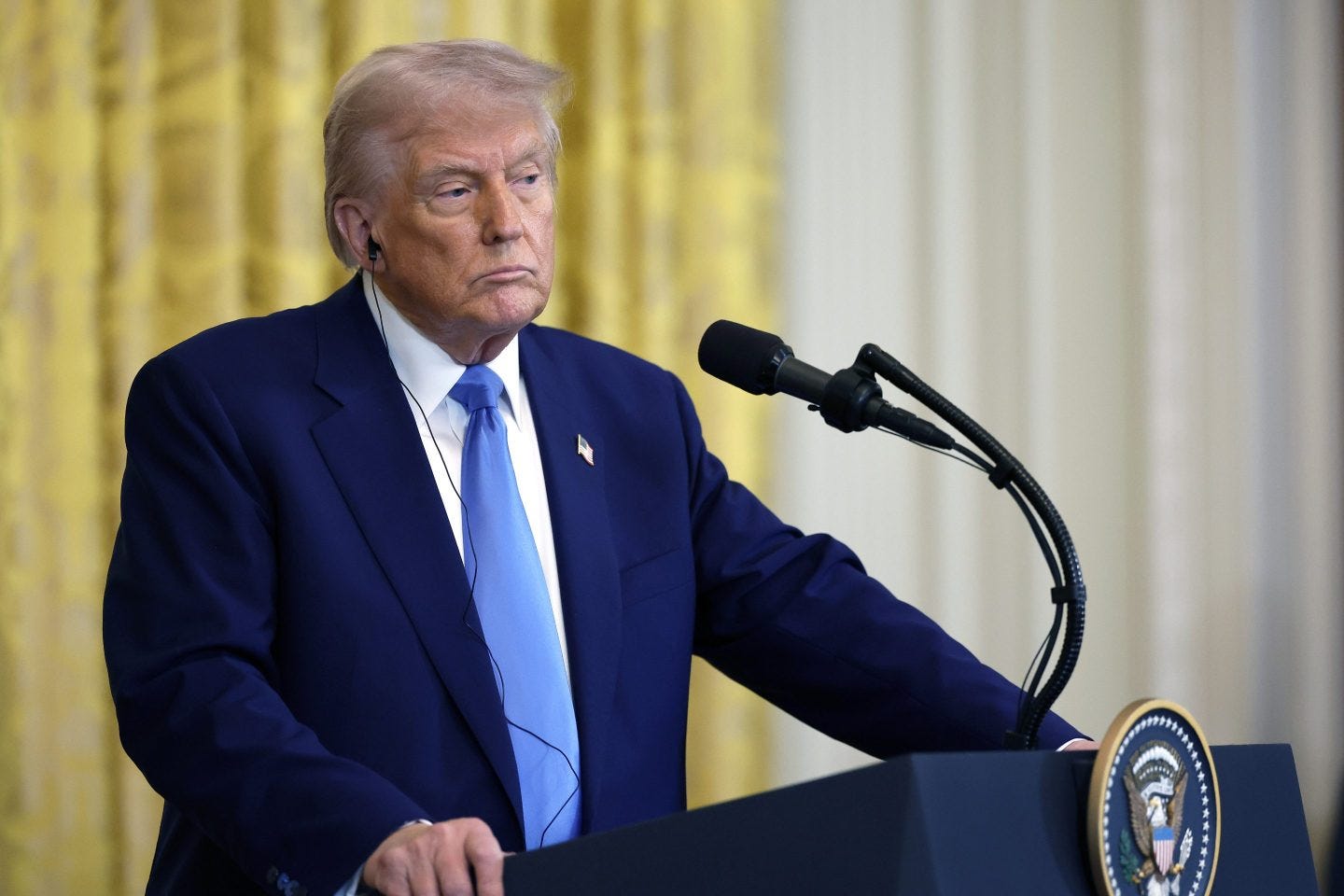
Trump says he can pay off $36 trillion in national debt by selling wealthy immigrants $5 million “gold card” visas. This is a perfect example of how the “national debt” mythology gets weaponized.
Here’s the thing most people don’t know: the U.S. hasn’t operated under a gold standard since 1971. Since then, we’ve been in what economists call a soft money regime... the federal government creates its own currency. It cannot involuntarily run out of dollars the way you or I run out of a paycheck.
That means the “national debt” isn’t a debt in any meaningful sense. There’s no payback liability. No creditor is going to repossess America. What we call the national debt is actually an accounting record of net dollars the government has spent into the economy and not taxed back. Those dollars are, dollar for dollar, private sector financial assets at home and abroad. (I explain the full mechanics here: chevan.substack.com/p/t…)
The U.S. has enjoyed a special status called “Global Reserve Currency” where the U.S. dollar is essentially the currency of the world. Trump has been destroying that status since he started his second term, with profound negative geo-political consequences to the world and negative economic consequences to the U.S.
Treasury securities, the thing people call “the debt”, are better understood as an investment product offered by the U.S. government that forms the stable base of the entire global credit system. If you want to understand why this matters: chevan.substack.com/p/w…
So when Trump says he needs to sell $5 million gold cards to “pay off” the national debt, the premise itself is nonsensical. You don’t need to pay off something that doesn’t function as a debt. And no, federal taxes don’t pay for government spending either... that’s another part of the mythology: chevan.substack.com/p/f…
A note on using ChatGPT to fact-check this: it won’t help. The discipline of economics itself is not scientific... it’s an ideology with math. Mainstream economics doesn’t practice falsification, it failed to predict the 2008 financial crisis, stagflation, and Japan’s lost decades, and it resolves disagreements through institutional power rather than evidence. ChatGPT is trained on this literature. Ask it about the national debt and you’ll get the orthodox answer back... the same answer that has been demonstrably wrong about deficits, inflation, and government solvency for decades.
You’re not getting a neutral analysis, you’re getting confirmation of the dominant ideology. To understand why the orthodox economics is wrong, you have to get into the actual mechanics of how money is created, how spending works, how inflation actually happens. That’s what I’ve tried to do in my essays. Conservative politics has spent 50 years corrupting the information landscape... including the entire discipline of economics... to justify austerity and wealth concentration. The economics you learned in school, the economics ChatGPT will give you, is the product of that corruption. (I wrote about exactly how and why here: chevan.substack.com/p/e… and what it would take to fix it: chevan.substack.com/p/h…)
The real question is: why create severe austerity... gutting agencies, slashing services, starving communities of capital to “pay off” something that doesn’t need paying off? You may not understand monetary operations and how fiat currency works but Trump and his advisors do. The answer is that austerity concentrates wealth. When you starve resources from ordinary people, the only ones who benefit are those with enough excess money and assets to weather the storm. That’s not fiscal responsibility. That’s neofeudalism... a modern version of lords and serfs, except the castle is a hedge fund. (More on where this leads: chevan.substack.com/p/5…)
The actual danger isn’t the national debt. It’s Trump threatening to default on or cancel it. This would destroy the credit markets that the entire global economy depends on.
Welcome to the battle. I’ve been saying exactly the same thing for the past 20 years on my blog, mythfighter.com. Rodger Malcolm, Mitchell.
We might begin by not calling it "debt." Perhaps "investment"?