

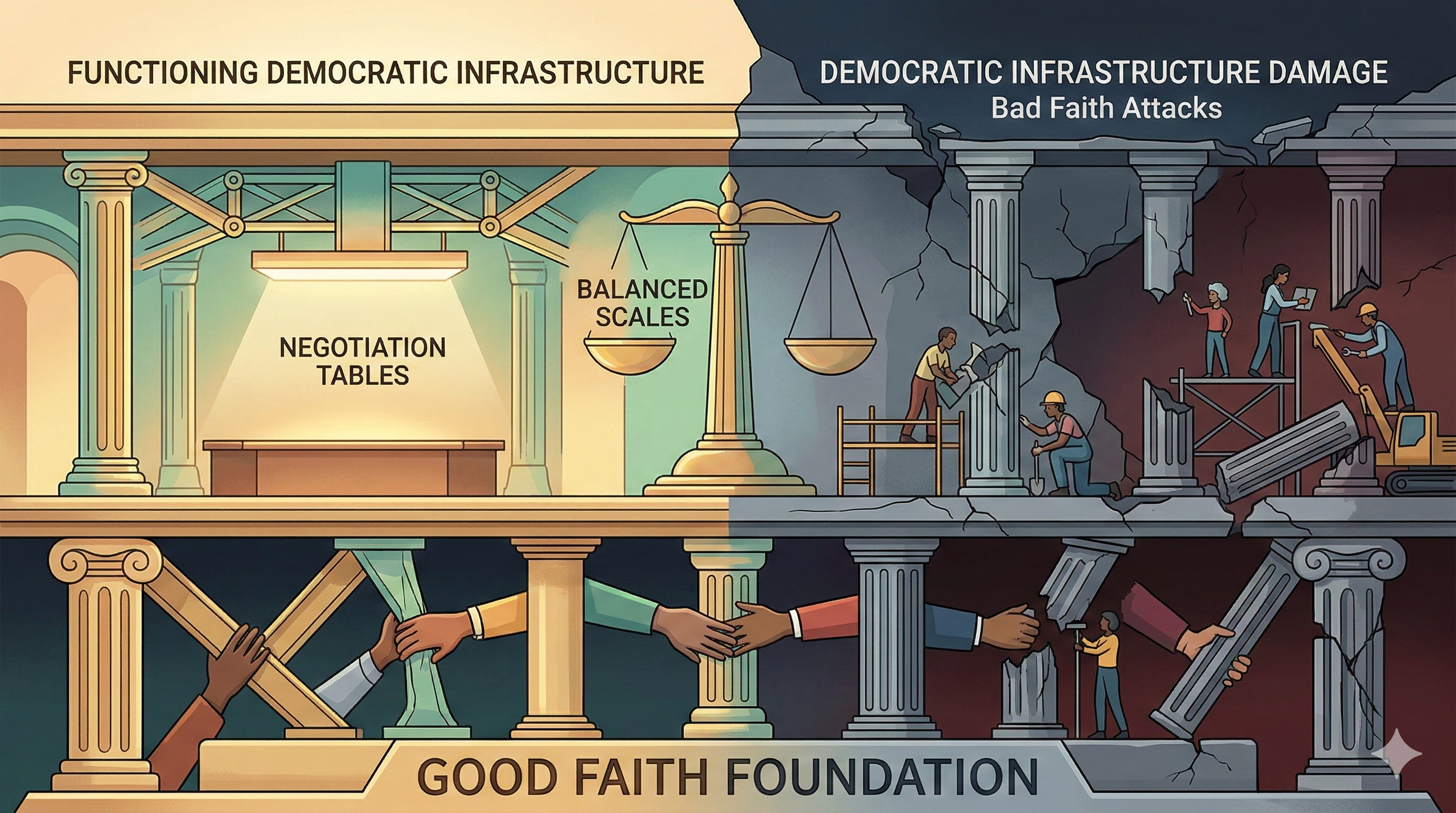
America is built on a foundation most Americans have never been taught about. Not the Constitution, though that matters. Not elections, though those matter too. Something more fundamental: the commitment that when Americans disagree, they negotiate in good faith. That everyone’s interests deserve a seat at the table. That the process of working things out together is what makes this country work. Good faith is American values in practice. It is the operating infrastructure of a nation founded on the idea that people who disagree can still govern themselves together. Human rights and inclusivity aren’t soft ideals. They’re the operating system of American democracy. And right now, a significant portion of the country is enthusiastically tearing that infrastructure apart.
Yesterday, the president started an unauthorized war against Iran, and a third of the country is celebrating. That’s not a policy disagreement. That’s the infrastructure cracking in real time. When a president bypasses the democratic process to launch a war nobody voted for, and millions cheer because the right people are getting hurt, something deeper than politics has broken. The building is leaning. Last week I wrote about being a builder. This week the demolition crew showed up.
Every building depends on a foundation you can’t see from the street. You notice the walls, the windows, the roof. You never think about the concrete and rebar underneath, until it cracks. Then you notice. America’s civic foundation works the same way. Good faith is the expectation that participants in democratic life will negotiate honestly, that they’ll treat opponents as wrong rather than evil, that they’ll honor the process even when they lose. When that expectation holds, you never think about it. When it breaks, everything built on top of it starts to fail.
Most Americans have never been taught this concept. Not in history class, not in civics, not in any formal education about how governance actually works. And that gap is not an accident. It’s the vulnerability. You can’t defend infrastructure you don’t know exists. You can’t name a violation you were never given vocabulary for.
People do reach for the phrase. “You’re not arguing in good faith” comes up on cable news, on social media, at family dinners that go sideways. And the instinct behind it is usually right. Something in our politics has broken, the arguments aren’t honest, the process isn’t working. But the phrase gets used as a personal accusation, a way to say “you’re being dishonest with me right now.” It stops there. This essay doesn’t stop there. Good faith isn’t a thing you accuse your uncle of lacking at Thanksgiving. It’s infrastructure. The structural foundation that makes democratic governance possible in the first place.
The difference matters. When good faith is just a personal accusation, it’s a weapon in an argument. When good faith is infrastructure, it’s something you can demand from institutions, measure in systems, and build into the way government operates. The personal accusation asks “is this person being honest with me?” The structural question asks “is this system designed to produce honest negotiation on behalf of all citizens?”
This essay will give you the framework to see it and the language to name it. What good faith actually looks like as American infrastructure. How it functioned when it worked. When and how it broke. Who broke it, and why. And something most people haven’t considered: the system that protects your interests, whatever they are, is the same system that protects everyone’s interests. Not because that’s a nice idea, but because that’s how the mechanism works. A democratic system that can be rigged to exclude some people is a system that can be rigged to exclude you. That’s not a political position. It’s a structural fact about how self-governance produces results.
Section 1: The Invisible Requirement
What does good faith actually look like in practice? It’s not agreement. People who negotiate in good faith disagree constantly, sometimes bitterly. Good faith is a set of baseline commitments that make disagreement productive instead of destructive.
Accept election results. When you lose, you accept the outcome and try to win next time. You don’t claim the election was stolen. You don’t try to prevent the peaceful transfer of power.
Honor institutional norms even when they’re inconvenient. Give Supreme Court nominees a hearing, even when the other party nominated them. Respond to Congressional subpoenas. Follow the laws you swore to uphold, including the ones you voted against.
Treat the opposition as wrong, not evil. You think the other side has bad policy ideas. You don’t think they’re enemies of the state or traitors. You can argue fiercely about taxes, healthcare, military spending, and education without claiming the other side wants to destroy America.
Compromise when you have power, expecting the same when you don’t. This is the hardest one. When your party controls Congress and the White House, you still negotiate with the minority. Not because you have to, but because you know you’ll be the minority eventually and you’ll want the same treatment.
Argue honestly about what you want and why. If you oppose a social program, say you oppose it on political grounds. Don’t disguise your political choice as an economic law. Don’t manufacture a false crisis to avoid making your actual argument. As I argued in Economics is not a Science, an entire intellectual apparatus has been built to do exactly this: present political choices as if they were natural laws, removing whole categories of democratic decision-making from the table before negotiation even begins.
Build systems that serve citizens, not insiders. Good faith isn’t just interpersonal. It shows up in how you design governmental systems:
Outcome measures – Can you tell if it’s actually working?
Transparency – Can citizens see how decisions are made?
Accountability – Can poor performance be identified and addressed?
Disclosure – Are conflicts of interest visible?
When systems have these four features, they serve citizens. When they don’t, they serve whoever controls them. System design is where good faith either becomes structural or stays rhetorical.
None of this requires people to agree. None of it requires anyone to give up their principles. It just requires accepting that everyone at the table is a legitimate participant in the process. That’s the invisible requirement.
This is what American governance looks like when it works. Not agreement. Not kumbaya. Fierce disagreement channeled through processes that protect everyone’s interests. That’s not weakness. That’s the system the founders built and that every generation of Americans has been responsible for maintaining. Good faith isn’t some invention of this essay. It’s already the foundation of American legal culture, the principle that makes contracts enforceable, negotiations meaningful, and democratic governance possible. When someone abandons these commitments, they’re not just “playing hardball.” They’re abandoning what makes America function.
Without it, democracy doesn’t have a mechanism to continue. The whole system assumes that elected representatives will negotiate solutions and honor agreements. When one side won’t negotiate, or won’t honor what they agreed to, there’s no enforcement mechanism. No referee steps in. The foundation just cracks.
Section 2: What It Looked Like When It Worked
Americans tend to think of political compromise as some lost golden age that never really existed. That’s wrong. Good faith negotiation produced real results within living memory, often between people who genuinely disagreed about fundamental questions.
The New Deal Coalition (1930s-1960s)
The New Deal wasn’t a kumbaya moment. It was forged from fierce disagreements between Northern urban Democrats and Southern rural Democrats, between labor unions and business interests, between progressives who wanted dramatic government expansion and moderates who didn’t. These factions disagreed about almost everything.
But they negotiated in good faith. They accepted each other as legitimate participants. The result was Social Security, the minimum wage, union protections, and massive public works programs that built the infrastructure Americans still use. Even fierce conservative opponents like Senator Robert Taft, who hated the New Deal, worked within the system. He argued against policies on their merits. He didn’t claim FDR was an illegitimate president or try to burn the system down. That was American governance. Disagree on policy, respect the process, try to win next time.
The New Deal coalition produced more than thirty years of broadly shared prosperity. Not because everyone agreed, but because they accepted the process.
The Great Society (1964-1965)
When Lyndon Johnson pushed for the Civil Rights Act, he didn’t have enough Democratic votes. Southern Democrats were filibustering the bill. So Johnson worked with Republican Senate Minority Leader Everett Dirksen. Dirksen was a conservative from Illinois. He didn’t agree with Johnson about most things. But he believed the civil rights legislation was right on its merits, and he was willing to break from segregationist Democrats to make it happen.
The bipartisan coalition that passed the Civil Rights Act, Medicare, Medicaid, and the Voting Rights Act wasn’t built on everyone liking each other. It was built on mutual recognition of legitimacy. Republicans provided the votes to defeat a Democratic filibuster because they evaluated the policy, not the party proposing it.
The Social Security Rescue (1983)
By the early 1980s, Social Security was heading toward insolvency. Ronald Reagan and Democratic Speaker Tip O’Neill could not have been more different politically. Reagan wanted to shrink government. O’Neill wanted to protect social programs. They disagreed about nearly everything.
They compromised anyway. The deal raised the retirement age, increased the payroll tax, and taxed benefits for high earners. Nobody loved it. Both sides took political heat from their bases. But they honored the agreement, and it stabilized Social Security for decades.
This is what patriotism looks like in practice. Not flag pins and rallies. Two leaders with opposing visions sitting down and doing the hard work of governing for all Americans. Making a deal neither side loves, and sticking to it because the alternative is worse for everyone.
The Clean Air Act Amendments (1990)
George H.W. Bush, a Republican president, worked with a Democratic Congress to pass sweeping environmental legislation. The compromise used market-based mechanisms (cap and trade for sulfur dioxide) that appealed to conservatives while achieving the environmental goals Democrats wanted. Business interests opposed it. Environmental groups wanted more. But the deal held.
Acid rain was reduced by 90 percent. It worked because both sides negotiated honestly about their goals, accepted the compromise, and let it function.
Every one of these examples shares the same feature: Americans who disagreed fiercely but respected the process. They treated their opponents as fellow Americans with legitimate interests. They compromised, honored agreements, and built things that worked. That’s the tradition. That’s the invisible infrastructure. That’s the inheritance. What follows is the story of how that inheritance was systematically squandered, and by whom.
Notice what every one of these compromises had in common. Both sides argued honestly about what they wanted and why. Reagan didn’t claim Social Security was “economically impossible.” He said he thought government was too big. O’Neill said he thought the safety net was worth protecting. They disagreed on values, not on reality. That honesty, that willingness to state your actual position rather than hide behind manufactured justifications, is what made productive negotiation possible.
Notice something else. In every one of these compromises, each side’s interests were protected better by the deal than they would have been by winning outright. Reagan got fiscal stability he couldn’t have achieved alone. O’Neill got a Social Security system that survived rather than one that collapsed under its own weight. Bush got market mechanisms for environmental policy. Democrats got clean air.
The reciprocity wasn’t just procedural courtesy. It was the mechanism that produced better outcomes for everyone at the table. Each side gave something up, and each side got something they couldn’t have gotten any other way. That’s not compromise as weakness. That’s the only process that works, because democratic governance is the only tool that can balance competing legitimate interests at scale. When it functions, everybody’s interests get addressed. Not perfectly, but reliably. That’s the track record.
Section 3: The Pattern of Breaking
Something changed. Not overnight, and not because of any single event. But over the last several decades, one side’s political project became fundamentally incompatible with good faith negotiation. As I documented in 50 Years of Economic Myths Have Delivered Americans Into Technofeudalism, this wasn’t accidental. It was a deliberate, decades-long campaign to reshape what Americans believe is possible through democratic governance.
The important distinction here is between voter motivations and political strategies. Many Republican voters support their party because of real fears and real insecurities: economic anxiety from decades of wage stagnation, cultural disorientation from rapid social change, legitimate concerns about their communities and futures. Those fears are real. They deserve to be addressed through honest policy debate.
But the political strategies deployed to capture and hold those voters don’t address those fears. They exploit them. And every one of those strategies requires breaking good faith.
The Southern Strategy (1960s-present)
After the Civil Rights Act passed with bipartisan support, the Republican Party made a strategic decision. Rather than competing for Black voters or accepting the expanding democratic participation that civil rights represented, the party chose to court white voters through coded racial appeals.
The Southern Strategy didn’t invent white working-class economic anxiety. That was real. But it channeled that anxiety into racial resentment rather than demanding systems that worked for all workers. The strategy required breaking good faith because you can’t honestly negotiate solutions for everyone while building your coalition on maintaining racial hierarchy. You can’t accept all Americans as legitimate democratic participants while your electoral strategy depends on denying some Americans’ full citizenship.
This wasn’t a policy position about how to make government work better. It was a strategy for using government power to sustain privilege.
The Corporate Capture of Economics (1940s-1980s)
As I argued in Economics is not a Science, corporate interests spent decades funding academic positions, think tanks, and research programs to reshape economics from an analytical toolkit into an ideological framework. The result: when Americans vote for universal healthcare, free public education, or infrastructure investment, they’re told these things are “economically impossible.” But they’re not impossible. They’re political choices that certain interests oppose. Disguising political choices as economic laws is bad faith at its most sophisticated, because it removes democratic decisions from the table before negotiation begins. It says “we can’t afford that” when the real position is “we don’t want to do that.” That’s not honest disagreement about policy. That’s manufacturing a false reality to avoid American democratic negotiation entirely.
The Gingrich Revolution (1994)
Newt Gingrich made the strategic choice to treat Democratic opposition not as political opponents but as enemies. His “Contract with America” wasn’t just a policy platform. It was a declaration that compromise itself was weakness, that governance meant winning, and that the permanent campaign had replaced the work of actually running a country.
Before Gingrich, congressional Republicans and Democrats might fight bitterly on the floor and have dinner together afterward. That wasn’t hypocrisy. That was good faith. It was the recognition that your political opponent is still your colleague, still a legitimate participant in the process, still someone you’ll need to work with tomorrow.
Gingrich destroyed that. He trained a generation of Republican politicians to see Democrats as the enemy, to use government shutdowns as leverage, and to treat any cooperation with the other side as betrayal. The permanent campaign meant there was never a moment to govern because governing requires the kind of compromise that Gingrich declared unacceptable.
Trump and the Escalation (2016-present)
Donald Trump took every previous break from good faith and amplified it. He demonized political opponents as “enemies of the people.” He refused to comply with subpoenas and Congressional oversight. He rejected election results. He pressured state officials to “find” votes. And on January 6, 2021, he attempted to prevent the peaceful transfer of power, the most fundamental good faith commitment in a democracy.
But Trump didn’t create this pattern. He inherited it. The Southern Strategy built the coalition. Corporate economics constrained the policy debate. Gingrich made opposition into warfare. Trump just stopped pretending.
But there’s a violation even more basic than any of those, and it’s one that should have been disqualifying before any of the rest happened.
Every modern president, regardless of party, has stood before the country and positioned himself as president of all Americans. This wasn’t just rhetoric. It was the most fundamental expression of good faith in the office: the acknowledgment that every citizen, including the ones who voted against you, has a legitimate stake in how you govern.
Barack Obama, 2004: “There is not a liberal America and a conservative America; there is the United States of America.” George W. Bush, 2001: “I will work to build a single nation of justice and opportunity.” Bill Clinton, 1993: “There is nothing wrong with America that cannot be cured by what is right with America.” You can argue about whether they lived up to those words. You can point to policies that favored one side or failed the other. But the verbal commitment mattered. It said: I see you. You belong here. Your interests are part of what I’m supposed to protect. That commitment is the bare minimum of good faith from someone who holds the office.
Trump never made it. Not once. His inaugural address gave America “American carnage,” not a unifying vision. He called political opponents “the enemy within.” He called the press “the enemy of the people.” He called fellow Americans “vermin,” “radical left thugs,” language designed not to defeat an argument but to deny that the other side is fully human, fully American, fully legitimate. That is the most basic good faith violation available to a president: refusing to acknowledge that the citizens who oppose you have any legitimate stake at all. It’s not just breaking the norms of the office. It’s rejecting the premise that the office exists to serve everyone.
This should have been disqualifying. When a president tells you, openly, that tens of millions of Americans are enemies, vermin, threats to be eliminated rather than citizens to be governed alongside, that person is telling you they will not negotiate in good faith. They cannot, because good faith starts with recognizing the other side’s legitimacy, and they’ve just told you they don’t. Every violation that followed, the refused subpoenas, the rejected elections, January 6, was downstream of this. The rhetoric was the signal. The rest was confirmation.
“Flood the Zone” (Bannon strategy)
Steve Bannon articulated a strategy that might be the purest expression of deliberate bad faith in American politics: “flood the zone with shit.” The idea is simple and devastating. If you overwhelm the public with so much disinformation, contradiction, and chaos that people can’t determine what’s true, you make shared reality impossible. And if people can’t agree on basic facts, they can’t negotiate solutions.
You can’t negotiate in good faith when you can’t establish what’s true. That’s not a side effect of this strategy. That’s the point.
The Through-Line
Look at the pattern across all of these:
The Southern Strategy says Black voters aren’t legitimate participants. Corporate economics says democratic majorities demanding social programs aren’t legitimate, disguising that exclusion behind the language of economic “laws” that aren’t laws at all. Gingrich says Democratic opposition isn’t a legitimate governing partner. Trump says Democratic election results aren’t legitimate. Bannon says shared reality itself isn’t legitimate.
None of these are policy positions. They are attacks on American democratic infrastructure. Each one requires denying the legitimacy of some group of Americans as democratic participants. That’s not conservative politics. It’s not even politics. It’s the systematic destruction of the system that makes American self-governance possible. And there’s a word for that: it’s un-American. You cannot negotiate in good faith with people whose legitimacy you refuse to recognize.
Section 4: The Citizenship Question
But strategies don’t operate themselves. Political strategies require voters who support them. And this is where the conversation has to get uncomfortable, because the through-line described above didn’t happen in a vacuum. It happened with the enthusiastic support of tens of millions of American citizens.
This essay has been careful to distinguish between voter motivations and political strategies. That distinction is real and it matters. Many Republican voters support their party because of genuine economic anxiety, legitimate concerns about their communities, real frustration with a government that doesn’t seem to work for them. Those fears deserve to be heard. Those interests deserve a seat at the table. Voting for a party because you’re worried about the economy, because you want stronger borders, because you think regulation has gone too far, those are legitimate political choices. Full stop.
But there’s a meaningful difference between voting for a party because you’re worried about the economy and enthusiastically celebrating when that party tears apart democratic processes. The first is a political choice. The second is bad faith citizenship.
And the record shows which one happened.
I had a conversation recently with a Trump supporter who said, without any sense of irony, that conservatives are tired of people coming in from outside, bringing their ideas, lobbying the political system, building support for change, and implementing things they don’t like.
Read that again. What this person described, point by point, is democracy. People arrive. They bring ideas. They advocate. They build coalitions. They win enough support to implement change. That is the American system working exactly as designed. Competition and new ideas is how a democratic society generates growth, innovation, and adaptation. It is the mechanism the founders built.
And this person was describing it as the problem.
They didn’t want to compete in the marketplace of ideas. They didn’t want to build a better argument and win. They wanted the privilege of their status quo preserved without doing any of the work that democracy demands. And if other people do that work, organize, advocate, build support, win, they still want those people to fail. Not because the ideas are wrong. Because the process itself, the process of democratic participation, threatens a position they believe they’re entitled to hold without defending it.
That’s not conservatism. Conservatism is a set of ideas about governance that competes honestly in the democratic arena. What this person described is authoritarianism: the belief that the democratic process should be constrained to produce only outcomes that preserve existing hierarchy. They didn’t use that word. They didn’t need to. The position speaks for itself.
This is what bad faith citizenship looks like before it gets to the Capitol steps. Before the rally, before the riot, before the refusal to accept election results. It starts here: with ordinary people who believe, sincerely, that democracy is only legitimate when it produces outcomes they approve of. That belief, held by millions, is the soil in which every strategy described in Section 3 grows.
When Donald Trump refused to accept the 2020 election results, his supporters didn’t hold their noses. They didn’t say “I wish he’d accept the outcome, but I still prefer his tax policy.” They showed up in Washington wearing his name on their bodies. They chanted his slogans. They stormed the Capitol. Not all of them, but enough, and millions more cheered from home.
When Trump refused to comply with Congressional subpoenas, his supporters didn’t express discomfort with the precedent. They called the subpoenas a witch hunt. They adopted his framing wholesale. When he attacked judges who ruled against him, calling them biased, questioning their legitimacy, his supporters didn’t defend judicial independence. They attacked the judges too. When he pressured a state official to “find” 11,780 votes, his supporters didn’t recoil at an attempt to fabricate an election outcome. They insisted the real fraud was on the other side.
Every time Trump demanded something that violated democratic norms, refusing subpoenas, attacking judges, claiming stolen elections, attempting to overturn results, his supporters didn’t hold their noses. They cheered. They adopted the violation as their own. That pattern of enthusiastic abandonment of inclusive processes, repeated every time the authoritarian demands it, is the definition of bad faith citizenship.
This matters because the distinction between tolerating violations and celebrating them is the distinction between political compromise and civic betrayal. Democracy can survive voters who reluctantly accept imperfect candidates. Every voter in every election does that. Democracy cannot survive voters who enthusiastically celebrate the destruction of democratic processes, because those voters aren’t just choosing a candidate. They’re choosing to dismantle the system that makes choosing possible.
When you cheer for a president who refuses to accept election results, you’re not expressing a policy preference. You’re endorsing the destruction of the process that protects your right to vote too. When you celebrate a leader who treats judicial independence as an obstacle, you’re not supporting strong leadership. You’re supporting the elimination of the institution that protects your rights when power turns against you. When you defend a president who refuses Congressional oversight, you’re not defending executive authority. You’re supporting a government that operates without accountability to the people it governs, including you.
This isn’t about policy. You can want lower taxes, stronger borders, less regulation, those are legitimate political positions that deserve a seat at the table. But when your support for those positions leads you to celebrate the destruction of the table itself, you’ve crossed from politics into something else.
And that something else has a name. It’s un-American.
That word gets thrown around cheaply in political arguments, so let me be precise about what I mean. America was founded on a specific idea: that people who disagree can govern themselves together through democratic processes. Not that they’ll always agree. Not that the process will be painless. But that the process itself, the negotiation, the compromise, the peaceful transfer of power, is what makes self-governance possible. That idea is the American idea. It’s what separates this country’s founding from every monarchy, empire, and dictatorship that came before it.
When you enthusiastically support the dismantling of those processes, you’re not defending America. You’re fighting against the thing that makes America what it is. You can’t claim to be a patriot while dismantling American democratic infrastructure. You can’t wave the flag while cheering for the destruction of the system that flag represents.
This is what un-American actually looks like. Not dissent. Dissent is among the most American things a citizen can do. Not protest. Protest is how democratic systems correct themselves. Not voting for candidates the other side dislikes. That’s democracy functioning. Un-American is the enthusiastic celebration of dismantling the democratic processes that allow all of those things to happen.
And the pattern isn’t subtle. It’s not a matter of interpretation or spin. Refusing to accept election results is a violation of the most basic democratic norm. Attempting to prevent the peaceful transfer of power is an attack on the foundation of the American system. Demanding that a president be above legal accountability is a rejection of the rule of law. These aren’t gray areas. These are the lines that separate democratic citizenship from something else.
The uncomfortable truth is that responsibility doesn’t stop with the politicians who deploy bad faith strategies. It extends to the citizens who embrace them. Not the citizens who reluctantly vote for a flawed candidate because the alternative seems worse, that’s the difficult compromise democracy always demands. But the citizens who show up with enthusiasm for the destruction. The ones who make the violation their identity. The ones who, given the choice between supporting democratic norms and supporting their leader’s demand to break them, choose the breaking, every single time, without hesitation.
That’s a choice. It’s a choice made by adults who have access to the same information as everyone else. And while the political strategies that manipulate fear are real, and the economic anxieties that make people vulnerable to those strategies are real, at some point the person cheering for the destruction of democratic processes bears responsibility for cheering.
You don’t get to celebrate the wrecking and then claim you were just worried about grocery prices. Not when the wrecking was the point. Not when you showed up for it, dressed for it, posted about it, made it your identity. The economic anxiety was real. The choice to channel that anxiety into enthusiastic support for dismantling democratic processes was a choice. And it was the wrong one.
This isn’t a call to write off Republican voters or treat them as irredeemable. The whole argument of this essay is that everyone’s interests deserve a seat at the table. But sitting at the table requires accepting that the table exists. It requires accepting that other people get to sit there too. It requires accepting outcomes you don’t like, because next time the outcome might go your way, and you’ll want the same process to protect your win.
Republican voters who want their economic fears addressed, who want competent governance, who want a country that works for them, those voters need the system this essay describes. They need good faith negotiation. They need democratic processes that function. They need a government that can actually solve problems instead of performing culture war while the problems get worse. Everything they say they want requires the infrastructure they’re helping to tear down.
The question isn’t whether you’re a good person or a bad person. The question is whether you’re willing to be a citizen, which means accepting the obligations that come with self-governance, including the obligation to defend the process even when it doesn’t give you what you want this time. That’s the citizenship question. And right now, a significant portion of the country is answering it wrong.
Section 5: Why This Breaks the Mechanism
This isn’t a personality problem. It’s not about individual politicians being mean or stubborn. It’s a philosophical incompatibility at the deepest level.
Good faith negotiation requires one thing above all else: accepting that every participant at the table is a legitimate participant. You can think they’re wrong about everything. You can think their ideas are terrible. But you have to accept that they have a right to be there and that the democratic process will determine outcomes.
American conservatism, as actually practiced over the last several decades, has been organized around maintaining hierarchies of power and privilege. Racial hierarchy. Economic hierarchy. Cultural hierarchy. This isn’t a secret. It’s visible in every strategy described above.
As I explored in Defending Democratic Capitalism from the Extreme Right, the philosophical roots run deep: far-right libertarian frameworks systematically delegitimize collective democratic action by labeling all government intervention as “coercion” and “violence,” while simultaneously requiring government enforcement of the property rights and market structures that sustain their privilege. That contradiction is fundamental bad faith. You can’t declare democratic governance illegitimate while relying on it to protect your position.
Here’s the philosophical problem: you cannot simultaneously maintain hierarchy and treat everyone as equal participants in democratic negotiation. Hierarchy means some people’s interests matter more than others. Equal participation means everyone’s interests are legitimate. These two commitments are mutually exclusive.
I wrote about this framework in The Politics of Stakeholder Society: the divide between universal stakeholding (everyone affected by collective decisions has a legitimate voice) and conditional stakeholding (participation is earned and can be revoked based on criteria that conveniently exclude people who threaten existing power arrangements). Good faith negotiation only works under universal stakeholding. Conditional stakeholding, by definition, rejects the premise.
That’s why good faith keeps breaking. Not because Republican politicians are uniquely dishonest as individuals, but because the political project they serve requires denying certain people’s legitimacy as democratic participants. If you accept Black voters as fully legitimate, the Southern Strategy collapses. If you accept that democratic majorities can direct economic resources, the corporate economics project collapses. If you accept that economics is a political framework rather than a natural science, the entire intellectual justification for limiting democratic choice falls apart. If you accept the opposition as a legitimate governing partner, the Gingrich strategy collapses. If you accept election results, the Trump project collapses.
The pattern isn’t random. It’s structural. The conservative political project, as currently constituted, cannot operate in good faith because good faith requires the kind of mutual recognition that would make hierarchy impossible to maintain.
This is the diagnosis. Not “Republicans are bad people.” Rather: a political project built on hierarchy is philosophically incompatible with good faith democratic negotiation, which requires treating all participants as equals.
Many Republican voters don’t consciously support hierarchy. They support their party because of real economic fears, real cultural anxieties, real concerns about their communities. Those motivations are legitimate and deserve to be addressed through honest policy debate. But the political strategies their party uses to capture and hold their support require breaking the very mechanism that could address those fears: good faith negotiation aimed at solutions that work for everyone.
There’s one more dimension to this diagnosis. Complexity is how bad faith hides. When systems are genuinely difficult to understand, false premises can be embedded in public discourse and sustained for decades. Economic mythology is the clearest example: the idea that “we can’t afford” popular social programs has been repeated so consistently that it functions as common sense, even though a Federal Reserve Chairman explained in 1946 that the premise is false. I’ve catalogued 31 specific assumptions designed to constrain what democratic majorities can demand. Complexity provides the cover. Hierarchy makes bad faith necessary. Together they produce a politics where the foundation has been cracking for decades while most people couldn’t see the damage.
And here is the irony that neither side sees. The people who break good faith to protect their position end up in a system that can’t protect anyone’s position.
Consider what happens. A Republican voter who supports bad faith strategies because of economic fear gets a government that can’t address economic fear, because the mechanism for addressing it has been destroyed by the very strategies they supported. A wealthy donor who funds bad faith politics to protect privilege gets an unstable society where privilege becomes precarious, because concentrated wealth in a dysfunctional democracy doesn’t stay secure. It becomes a target.
The system that protects the donor’s interests is the same system that protects the worker’s interests, the same system that protects everyone’s interests. There is no version of democratic governance that works for some people and not others. There’s only a version that works and a version that doesn’t.
This is the moral thesis at the center of this essay: protecting your own interest requires a system that protects everyone’s interest, because that is the only kind of system that functions. Not as idealism. As mechanism. As structural fact.
Every attempt to rig the system in favor of one group degrades the system’s ability to serve any group, including the one doing the rigging. That’s why hierarchy and good faith are incompatible. Hierarchy says some people’s interests matter more. But a system built on that premise can’t produce stable outcomes for anyone, because the people whose interests are excluded don’t disappear. They push back, check out, or get desperate. And the system grinds down under the weight of its own contradictions.
This is what we’re living through right now. And it should concern everyone: left, right, rich, poor, every person who depends on the system to function. Which is all of us.
All of this produces anti-government ideology as a mass political phenomenon, and this is where the loop closes. The strategies in Section 3 each involve deliberately breaking some piece of democratic governance. Put them together and you get a government that genuinely does not function well for ordinary people, not because government is inherently incompetent, but because it has been deliberately degraded by people who benefit from its dysfunction.
Ronald Reagan set the terms in his 1981 inaugural address: “Government is not the solution to our problem; government is the problem.” Consider the irony of that sentence. A man who just convinced the American people to make him the most powerful government official on earth used his first official act to tell them that the institution they’d just entrusted to him was the enemy. He ran to be the steward of something he was publicly committed to dismantling. And Americans cheered. They’ve been cheering ever since. That is the foundational act of self-fulfilling political prophecy: elect leaders who believe government can’t work, watch them make government not work, then accept their conclusion that government was never going to work. The cycle didn’t start by accident. It started with a president standing at the podium and telling the country to stop believing in the thing he’d just been hired to run.
Then comes the move that makes the whole project self-sustaining. The same political actors who broke the system point to the broken system and say: “See? Government doesn’t work. Government is the problem.” And millions of Americans, experiencing real dysfunction, nod along. The frustration is legitimate. The diagnosis is false. Government isn’t failing because it’s government. Government is failing because specific people broke the mechanisms that make it work. Break the system, blame the system, use the public’s justified frustration to break it more. The cycle is self-reinforcing.
But we know the diagnosis is false, because we have the receipts. The U.S. government manufactured the most prosperous middle class in human history. That wasn’t an accident. It was deliberate policy: the GI Bill, progressive taxation, union protections, public universities, Social Security. A government that recognized a strong middle class distributes power, and that distributed power is what makes democratic governance stable. Those programs worked. The middle class they built was the proof. Then different people, with different priorities, wrote different laws that took it apart. And now the demolition crew points at the rubble and says government was never any good at building.
As I documented in Venezuela Is a Symptom, this wasn’t abstract ideology. Specific actors funded it and profited from it, donating to both parties to ensure that regardless of who won elections, the policy boundaries stayed favorable to concentrated wealth. That bipartisan complicity is why the dysfunction feels so total: voters keep changing parties and nothing changes.
If government dysfunction is the intended outcome of a political project designed to concentrate power and wealth, then the answer isn’t less government. It’s government that works: with outcome measures, transparency, accountability, and disclosure. Those four features aren’t bureaucratic ideals. They’re the direct counter to a strategy that depends on keeping American governance broken and opaque.
Section 6: What This Explains
I grew up the child of Sri Lankan immigrants. That gave me something most Americans don’t have: a regular outside view. I’ve traveled to every continent except Antarctica, starting young, and for most of my life the observation I heard from people overseas was remarkably consistent. America wasn’t perfect. It had been the aggressor more often than not for a century. But the way its government operated, with a kind of self-restraint and transparency that other countries recognized even if Americans took it for granted, produced tangible results. A higher standard of living. Better technology and infrastructure. Geopolitical stability that the rest of the world organized itself around. American democratic governance was a symbol because it functioned.
In the Trump era, traveling overseas, all I hear is: “What happened?”
That question is what this section answers.
Why “just compromise more” doesn’t work. Compromise requires good faith. When one side’s political project depends on denying the other side’s legitimacy, no amount of willingness to compromise can make the mechanism function. It’s not that Democrats haven’t tried hard enough to reach across the aisle. It’s that reaching across requires someone on the other side who accepts your right to be there.
There’s a saying I first heard in a 9th grade political science class: “A good compromise is one that all parties hate.” It sounds wise. It’s supposed to capture the maturity of accepting that nobody gets everything they want. But here’s why that saying has curdled into cynicism for so many people: it assumes both sides showed up to negotiate honestly. When they did, yes, compromise means everyone gives something up and nobody’s thrilled. That’s democracy working. But when one side negotiates in good faith and the other side doesn’t, “compromise” doesn’t mean meeting in the middle. It means the honest side keeps giving ground while the dishonest side just takes. Do that enough times and compromise starts to feel like surrender with better branding. The saying isn’t wrong about what compromise should feel like. It’s describing a system that only works when good faith is present on both sides. Without that, the people who keep showing up to negotiate honestly aren’t being mature. They’re being played. That’s not an argument against compromise. It’s an argument for demanding good faith as the prerequisite.
Why something feels fundamentally broken. People can tell the difference between disagreement and bad faith, even if they can’t name it. When politicians disagree about tax rates, that’s politics. When politicians claim elections are stolen, refuse to honor agreements, and treat the opposition as enemies of the state, that’s the invisible foundation cracking. People can feel the building leaning even if they can’t see the concrete.
Why the asymmetry matters. People sometimes say “both sides do it.” They don’t. Both sides play hardball politics. Both sides spin and exaggerate. But only one side has systematically denied the legitimacy of the other side’s participation in democracy. Only one side has refused to accept election results. Only one side has attempted to prevent the peaceful transfer of power. That’s not political disagreement. That’s an assault on American values. The asymmetry isn’t a matter of opinion. It’s a matter of record.
Why “Democrats aren’t doing anything” is exactly backward.
When Trump flouts the law, ignores court orders, bypasses Congress, and defies established procedure, then turns around and says “the Democrats aren’t doing anything,” he’s exploiting a perceptual trap. Democrats are doing something. They’re operating within the governing framework: following the law, respecting court rulings, honoring institutional processes. From outside the framework, from the perspective of someone who has abandoned every constraint, that looks like weakness. It looks like nothing.
This reveals a role reversal neither side has fully named. Democrats are the conservatives here. They’re enforcing and upholding the constitutional system, defending institutional norms, insisting that laws apply to everyone. Republicans under Trump are the radicals. They’re tearing down governing structures that every previous generation of American leaders maintained.
The deeper principle is restraint. American democratic governance has been historically powerful not because leaders grabbed everything they could, but because they chose not to. Every president who submitted to Congressional oversight, honored court rulings they disagreed with, or accepted electoral defeat was choosing to be constrained by the system rather than overpower it. That restraint was good faith made visible. It was what made their power legitimate.
Trump’s unrestrained exercise of power looks like strength only if you’ve forgotten what legitimate power looks like. A president who ignores courts and defies Congress isn’t strong. He’s abandoned the commitment that makes presidential power legitimate in the first place.
That’s the optical illusion at the heart of this crisis. Good faith looks like inaction because it operates within constraints. Bad faith looks like action because it ignores them. The person following the rules appears passive. The person breaking them appears powerful. But what they’re getting done is the destruction of the system that protects everyone, including the people cheering.
Why abandoning good faith leads somewhere dangerous. When you break the mechanism of democratic negotiation, you don’t get freedom from government. You get a power vacuum that authoritarianism fills. As I argued in Why Progressives Are Accidentally Helping Authoritarians Win, the dismantling of democratic collective action doesn’t lead to liberty. It leads to submission. The path from breaking good faith to authoritarianism isn’t hypothetical. We’re watching it happen.
Why the fear is real even when the strategies are cynical. Republican voters who feel afraid about the economy, their communities, or the pace of cultural change aren’t wrong to feel those things. The problem is that the political strategies offered to them, strategies built on hierarchy and bad faith, can’t actually solve those problems. You can’t build shared prosperity while denying some people’s legitimacy as participants. The voters who support bad faith strategies out of fear don’t get the security they’re looking for. They get culture war, dysfunction, and a government that can’t solve problems because it can’t negotiate solutions.
Why nobody is coming to save us. As I argued in Be a Builder, broken systems do not fix themselves, and nobody else is coming to fix them for us. No candidate, no court ruling, no election cycle is going to restore good faith from the top down. America once had political stewards who built the middle class through law: progressive taxation, Social Security, union protections, the GI Bill, public universities. That wasn’t natural. It was a political achievement, constructed through democratic negotiation. Then different legislators wrote different laws that systematically reversed those achievements. The stewards got replaced by people whose primary commitment was to concentrated wealth rather than broad prosperity. The strategies in Section 3 were the machinery of that transformation. Oligarchy doesn’t reform itself. The only cure is for people to take it back.
The reason to demand good faith isn’t altruism. It’s self-interest, correctly understood. Every period of broadly shared American prosperity had the same feature: participants accepted each other’s legitimacy and negotiated for mutual benefit. Every period of decline had the same feature too: some group tried to protect its interests at everyone else’s expense and ended up degrading the system that could have protected those interests in the first place. Protecting everyone’s interest is how you protect your own. Not as a slogan. As a structural fact about how democratic systems produce outcomes.
The path forward isn’t waiting for better leaders. It’s citizens, across the spectrum, demanding that their representatives negotiate in good faith on behalf of all Americans. Not hoping for it. Demanding it. Demanding good faith isn’t asking Republicans to become Democrats. It’s asking everyone to insist that their representatives govern for all Americans, not just their base. As I wrote in Defending Democratic Capitalism Through Capacity Stewardship, this means demanding evidence-based decisions, institutional quality, and accountability for stewardship of public capacity. That’s not a partisan agenda. That’s the baseline for functional American governance.
And here’s what good faith governance actually produces: fair competition. Not the libertarian fantasy where you strip away rules and let the strongest win. The opposite. Fair competition requires active governance. Someone has to maintain the playing field: enforce antitrust law, prevent fraud, ensure transparency, break up concentrations of power that rig the game before it starts. Every period of broadly shared American prosperity, every era when the middle class grew and ordinary people could build wealth, had that feature. The government kept the field level. When it stopped, the field tilted, and the wealth flowed upward.
This is historical record, not idealism. The GI Bill, antitrust enforcement, securities regulation, consumer protection, public investment in infrastructure and education: these weren’t constraints on competition. They were the conditions that made competition real. Bigger markets. More participants. More people with the resources to start businesses, buy homes, send their kids to college. Fair competition is the engine that builds a middle class, but only when someone is actively maintaining the machinery. Leave it unattended and the biggest players capture it. That’s not competition anymore. That’s extraction.
A rigged game where incumbents write the rules, where regulatory capture replaces regulation, where concentrated wealth buys the policy outcomes it wants, isn’t a free market. It’s a protection racket with better branding. The people defending deregulation as “freedom” are defending the freedom of the powerful to eliminate the competition that would hold them accountable. Good faith governance fights that. It insists that markets serve the public, not the other way around. That’s the direct connection between the democratic infrastructure this essay describes and the economic outcomes people actually care about.
None of this requires you to change your political beliefs. If you’re a conservative who wants smaller government, demand that your representatives argue for it honestly, on its merits, instead of hiding behind manufactured economic crises. If you’re a progressive who wants expanded social programs, demand that your representatives build those programs with outcome measures and accountability. The content of what you demand is your own. The insistence on good faith is what we all share. And when representatives actually negotiate in good faith, the policy frameworks that emerge look like Opportunity Economics: coalitions built around shared economic interests, broadly shared prosperity, and an honest accounting of who benefits and who pays. That’s not utopian. That’s what happened during every period of good faith negotiation described in this essay.
Section 7: What to Say
Everything above gives you the framework. This section gives you the language. Not talking points, not slogans, but phrases you can use in real conversations when someone is defending bad faith and you need to name what’s happening. These are organized by the situations where they come up most often.
When someone claims “both sides do it”
This is the most common deflection, and it works because it contains a grain of truth. Both sides do play hardball politics. Both sides spin and exaggerate. But that’s not what you’re talking about, and the person saying it knows that.
Try: “Both sides play hardball. Only one side refused to accept an election result. Only one side tried to prevent the peaceful transfer of power. Those aren’t equivalent.”
Or: “Show me when Democrats attempted a coup. Show me when Democrats told a Secretary of State to ‘find’ votes. The asymmetry is in the record.”
The goal isn’t to claim Democrats are perfect. The goal is to refuse the false equivalence that treats policy disagreement and the destruction of democratic processes as the same thing. They’re not. Name the specific violations. Make the person respond to what actually happened, not to an abstraction.
When someone defends Trump’s norm violations
People defend these violations in different ways. Some minimize them (“every president pushes boundaries”). Some justify them (“he had to because the system was rigged against him”). Some celebrate them (“finally someone who fights”). Each of these requires the same response: connect the violation to the infrastructure it destroys.
Try: “That’s bad faith. American democracy depends on processes that include everyone’s interests. When you support bypassing those processes, you’re fighting against American values.”
Or: “You’re dismantling the infrastructure that protects everyone, including you.”
Don’t get drawn into debating whether a specific violation was technically legal or whether previous presidents did something vaguely similar. The question isn’t legality. The question is whether you support a system where democratic processes constrain power, or whether you support a leader who operates without those constraints. There’s no middle ground on that question, and forcing clarity on it is more productive than arguing about details.
When someone uses economic mythology
This is the one that sounds like common sense but isn’t. “We can’t afford universal healthcare.” “The national debt is out of control.” “If you raise the minimum wage, businesses will close.” These aren’t economic arguments. They’re political choices wearing the costume of natural law.
Try: “That’s not economics. That’s a political choice disguised as a natural law. Say what you actually believe so we can have an honest argument.”
Or: “We can afford bank bailouts and tax cuts for billionaires but not healthcare? That’s not a budget constraint. That’s a priority list.”
The power of economic mythology comes from the assumption that regular people can’t challenge it. You can. You don’t need an economics degree. You just need to notice the selective application. The same people who say “we can’t afford” social programs never say “we can’t afford” military budgets or corporate subsidies. That inconsistency is the tell. Point at it. Make them explain it.
When someone calls for “unity” without accountability
After every violation of democratic norms, the call for “unity” follows like clockwork. Move on. Heal. Stop being divisive. This sounds reasonable until you notice what it’s actually asking: that the people whose democratic participation was attacked should pretend it didn’t happen, while the people who attacked it face no consequences. That’s not unity. That’s impunity.
Try: “Unity requires good faith. Good faith requires accepting everyone’s legitimacy as a participant. Start there.”
Or: “You want unity? Stop supporting leaders who call half the country enemies of the state.”
Real unity is possible. It’s what the New Deal coalition had, what the bipartisan compromises of the 1980s and 1990s had. But it requires the same thing every time: mutual recognition that everyone at the table is a legitimate participant. You can’t unify with someone who denies your right to be at the table. The demand for unity has to come with the demand for good faith, or it’s just a demand for silence.
When someone describes democratic participation as the problem
Sometimes the bad faith isn’t hidden at all. Someone tells you they’re tired of outsiders coming in, bringing new ideas, lobbying for change, building support, and winning. They think they’re describing an injustice. They’re describing democracy.
Try: “You just described how democracy works and called it a problem. Competition and new ideas is how this country grows. If you want your position to win, make the argument. Don’t try to lock the door.”
Or: “You want your status quo preserved without doing the work? That’s not conservative. That’s authoritarian.”
The Foundation
Here is the thing this essay has been building toward:
A democratic system that can be rigged to exclude some people is a system that can be rigged to exclude you. That’s not a warning about fairness. That’s a warning about mechanics. The system that protects your interests, whatever those interests are, is the same system that protects everyone’s interests. Not because that’s generous. Because that’s how the mechanism works. Break the mechanism for someone else and it’s broken for you too. You just haven’t found out yet.
This isn’t just smart strategy. It’s American. The foundational American idea was never that we’d all agree. It was that we’d work it out together through processes that protect everyone at the table. Human rights, inclusive participation, good faith negotiation. These aren’t soft liberal values bolted on after the fact. They’re the operating infrastructure of a country built on the radical premise that self-governance is possible. You can’t love the country and hate the foundation it’s built on.
So when you defend inclusive processes, you’re not being nice. You’re being American. When you call out bad faith, you’re not being divisive. You’re defending the system. When you refuse to let someone wrap the flag around the demolition of the thing the flag represents, you’re claiming the moral ground that belongs to anyone who takes this country seriously.
That’s the patriotic imperative right now. Not flag pins. Not anthem performances. Not slogans about greatness. The actual work of insisting that American democracy means what it says: that everyone’s interests matter, that power answers to process, that disagreement gets resolved through negotiation rather than domination. Defending good faith is defending America. The rest is decoration.
The foundation is cracking. Not someday. Now. The question is whether enough Americans care about the real thing to fight for it.
Chevan
This is a good wishlist for a better democracy. One aspect that I think needs some refining is the legitimacy issue. True it is that American politicians used to "agree to disagree" and let the rules of procedure and the majority vote make the decision. This worked "well" for a long time . . . . . up until the Civil Rights Act.
When African-American politicians started becoming elected and influential in Congress, this soft guardrail broke down. One side started de-legitimizing the other side---and the other side did not exactly take the high road.
In other words, when white people dominated Congress, they could agree to disagree. Throw in some people of color, the white people start fighting aggressively against other white people of the different political tribe.
This point was made in the popular political book "How Democracies Die." The Civil Rights Act changed the culture in Congress.
There are all sorts of implications here. I'm seeing that "Golden Age of Politics" was not exactly all that golden.